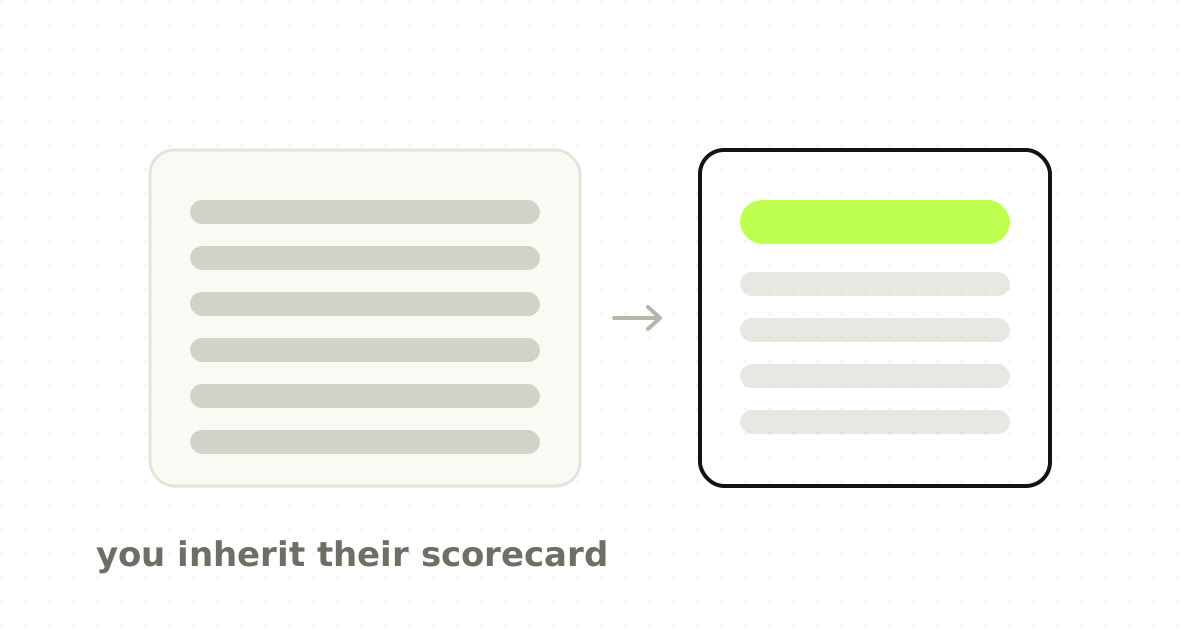
The frame you borrow comes with a scorecard
I am using red zone messaging here as a working label rather than an established term. It means messaging that explicitly frames your product against a dominant incumbent. The X alternative. Built for teams that have outgrown X. Without the complexity of X.
The red zone begins the moment your claim causes a buyer to judge you on the incumbent's job, reputation, integrations, switching cost and proof.
That can be useful when the comparison is already happening in their head and you have a narrow, provable reason to win it. It becomes expensive when you manufacture a rivalry nobody was considering, attack a product still good at its core job, or promise replacement before you have solved migration.
Your first competitor is often not a vendor
April Dunford's competitive-alternatives framing is the right starting point. The question is not who has similar features. It is what this buyer would do if you did not exist.
Sometimes the answer is a named vendor. Often it is a spreadsheet, a manual process, a module inside a larger suite, an internal tool, or no change at all. Each alternative demands a different message.
Against doing nothing, the job is making the cost of staying visible. Against a spreadsheet, it is naming the failure mode that appears at a specific volume or risk level. Against an internal tool, it is maintenance and opportunity cost, not insulting the team who built it. Against a dominant vendor, it is explaining the exact condition under which a buyer should choose your narrower approach.
Direct incumbent messaging makes sense only if the incumbent is a real alternative in actual deals. Otherwise you are running free brand advertising for a company the prospect was not thinking about.
Why it is so tempting
The incumbent hands you a ready-made mental model. "The faster alternative to X for security teams" says more in one line than a paragraph of category education. The buyer already knows what X is, what job it does, and roughly what adopting it means.
That borrowed context lowers explanation cost. It also creates search demand around comparison and alternative queries from buyers already in market.
But the context is not free. Name the incumbent and you borrow its evaluation criteria. If X is known for a deep integration ecosystem, enterprise governance and ten years of reliability, the buyer will ask whether you match those, even when your real advantage is that a small team can be live in a day.
The comparison helps only when your wedge survives the comparison it invites.
The replacement trap
A founder can be right that an incumbent frustrates users and still be wrong to position as a total replacement.
The issue is scope. A new product may be dramatically better at one recurring job while the incumbent remains better across the category. Say "we replace X" and the buyer evaluates the whole surface area. You lose on permissions, integrations, edge cases and procurement familiarity before the narrow advantage gets a hearing.
A useful challenger sentence is usually closer to "for teams doing Y, the X workflow breaks at Z" than "X is broken." One is a testable market claim. The other is theatre.
Switching cost is part of the copy
Incumbency is not only brand awareness. It is habit, stored data, integrations, workflow knowledge, procurement history, training and fear of disruption.
Research on incumbent-system use published in MIS Quarterly found that habit, perceived transition cost, sunk cost and inertia can reduce both perceived advantage and intention to adopt a new system. That is why a technically better product still loses to good enough.
So the message cannot stop at being better. It has to answer the switching story: what becomes easier, for which buyer, what migrates and what does not, whether they can pilot without a big-bang replacement, and what proof shows switching risk is lower than staying risk.
A page that attacks the incumbent while hiding migration until the sales call creates emotional contrast without removing practical risk.
The five-gate test
Before building a homepage, comparison page or campaign around an incumbent, I would require five gates green.
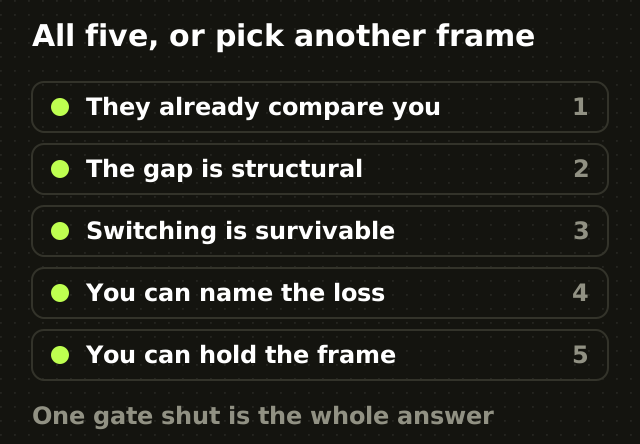
- The incumbent appears in real buyer behaviour. Check sales calls, win-loss notes and inbound queries. Do qualified buyers say the name unprompted? If not, stay out. 2. The pain is structural, not a temporary feature gap. A useful wedge comes from something the incumbent is disincentivised to solve: suite architecture, services-heavy implementation, pricing structure, a different target segment. They can ship dark mode. They cannot easily un-become an enterprise suite. 3. Your advantage is narrow enough to prove. Faster is vague. Go live without a six-week implementation is testable. The tighter the claim, the less room a prestige incumbent has to win on general reputation. 4. You can tell the switching story honestly. If customers need three months of migration and security review, say so, and design a phased path. The most persuasive challenger messaging shrinks the perceived size of the decision. 5. You have proof that survives a sceptical comparison. A named customer who switched, a documented implementation time, a live walkthrough and transparent limits beat a fourteen-column feature chart with green ticks down your side.
Where to place it
The homepage is the strongest placement because it makes the competitive frame part of the brand. That is right only when the frame is already central to how the market understands the purchase.
Consider homepage-level incumbent messaging when a large share of best-fit buyers already evaluate the incumbent, the dissatisfaction is consistent across calls, your wedge cannot be erased in one release, you have switching proof, and being compared directly makes the product easier to understand rather than harder.
Otherwise keep the homepage focused on the buyer and move named competition later in the journey: comparison pages, migration pages, paid-search landing pages, sales follow-up. That placement decision belongs to the same layer as deciding whether the site needs a redesign at all.
Contrast is not hostility
The best comparative messaging helps a buyer choose. It does not require cheap shots.
The US Federal Trade Commission's policy on comparative advertising is a useful guardrail even for teams operating globally: naming competitors can provide valuable information when comparisons are truthful, clear and non-deceptive, and objective claims should be substantiated. Other jurisdictions have their own rules, so legal review matters for explicit factual comparisons.
Honesty is also the stronger strategy. Saying that X is a better fit if you need global suite breadth, while you are built for teams who need this one workflow live quickly, increases credibility because it defines the boundary of the product.
The message stack
If the gates are green, build the page in this order.
- Buyer situation. Name the exact moment the incumbent stops fitting. 2. Contrast. Explain the structural difference in approach, not a pile of features. 3. Proof. Show the mechanism and evidence immediately. 4. Switching path. Migration, implementation, coexistence, risk. 5. Honest boundary. Say who should stay with the incumbent. 6. Next step. The smallest credible action: a migration assessment, a workflow demo, a pilot.
That sequence turns the incumbent from a villain into a reference point, and keeps the buyer as the protagonist.
The point
Positioning directly against an incumbent is neither inherently bold nor inherently weak. It is a choice about which scorecard you will be marked against.
Use the frame when the buyer already holds it, your advantage is structural, the switching story is credible and the proof is specific. Avoid it when the rivalry lives mostly in your own head.
A challenger wins by making one important buying decision easier. Not by shouting the incumbent's name louder.
Frequently asked questions
- When should a B2B SaaS position directly against a competitor?
- When qualified buyers already name that competitor unprompted in sales calls and inbound queries, your advantage comes from something structural the incumbent is disincentivised to fix, the claim is narrow enough to demonstrate, and you can describe migration honestly. If the comparison is not already in the buyer's head, naming it advertises the incumbent for free.
- Why is positioning as a total replacement risky?
- Because it invites evaluation of the incumbent's entire surface area. A challenger may be dramatically better at one recurring job while the incumbent remains stronger on integrations, permissions, edge cases and procurement familiarity. Claiming replacement means losing on those before the narrow advantage is heard. Owning one job beats claiming the whole category.
- How does switching cost affect competitive messaging?
- Heavily. Research on incumbent-system use found that habit, perceived transition cost, sunk cost and inertia reduce both perceived advantage and intention to adopt. A message that only argues you are better ignores the actual barrier. Name what migrates, what does not, whether a pilot is possible, and what evidence shows switching risk is lower than staying risk.
- Is it legal to name a competitor in marketing?
- Comparative advertising is permitted in many jurisdictions when comparisons are truthful, clear and non-deceptive, and objective claims are substantiated. The US Federal Trade Commission's policy treats it as potentially valuable information for buyers. Rules differ by country, so explicit factual comparisons warrant legal review before publication.
Sources
This thinking, applied
Share this