What the study did
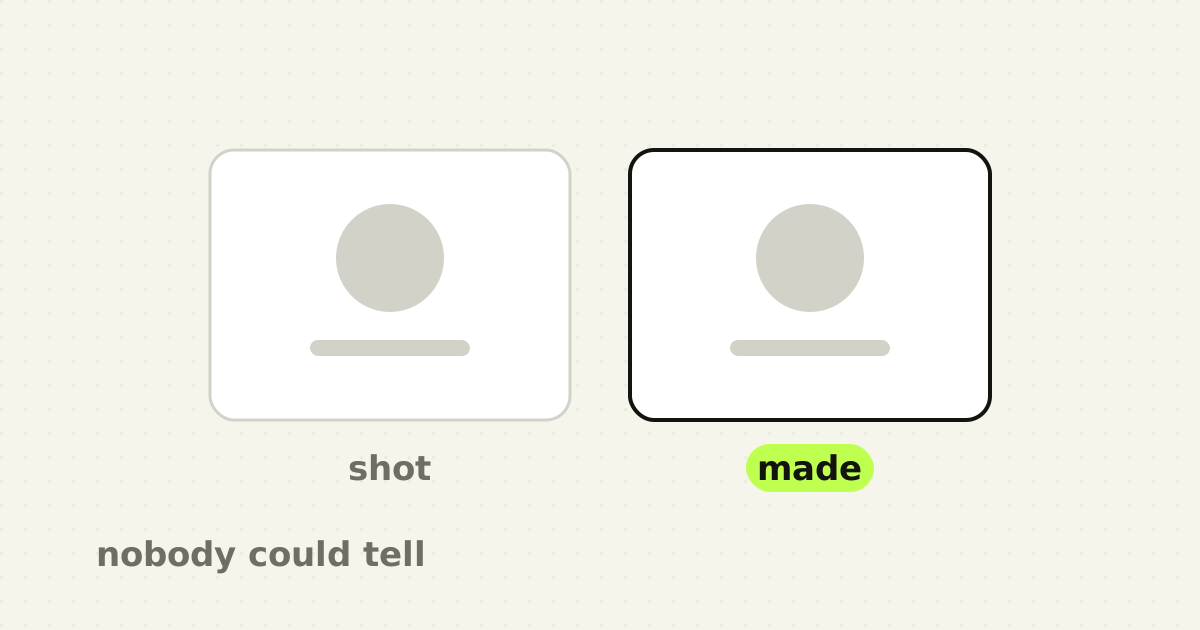
Nielsen Norman Group published research in August 2026, authored by Rachel Banawa, testing whether people can tell the difference between AI-generated hero imagery and licensed stock photography, and whether it changes how they judge a company.
77 US adults each viewed six versions of a landing page for a fictional consulting firm. The pages were identical apart from the hero image: three used stock photos, three used images generated with ChatGPT Images 2.0. Participants saw each page for ten seconds, then rated it on trustworthiness, professionalism and authenticity using seven-point scales.
Critically, participants were not told the study had anything to do with AI. They were judging pages, not sources. That design choice is the whole study: it measures whether AI imagery underperforms when the viewer has no idea it is AI.
The result was parity, not victory
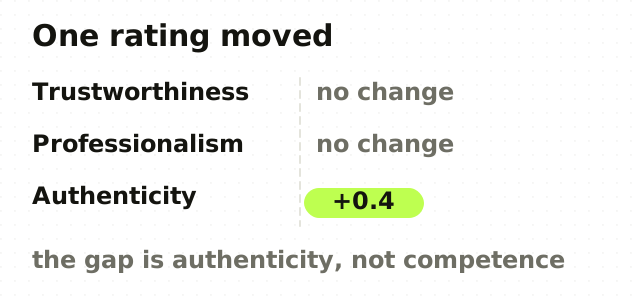
According to NN/g's research, the AI-generated images rated slightly higher on all three measures. Only one of those gaps was statistically significant: authenticity, by about 0.4 points on the seven-point scale. The differences in trustworthiness and professionalism did not clear significance.
It would be easy, and wrong, to read this as AI images being better. A 0.4-point edge on one dimension against a category as thoroughly mediocre as generic corporate stock photography is a low bar cleared, not a triumph. The honest summary is that origin stopped predicting the rating once the viewer could not see the origin. What predicted the rating was whether the image was any good.
There is also a sample worth being clear about: 77 participants, six images, one industry, one page type. NN/g flags this themselves. Workplace scenes on a consulting site are close to the ideal case for image generation. Product photography, real premises, actual staff and anything requiring documentary truth are nowhere in this data.
The finding buried in the caveats
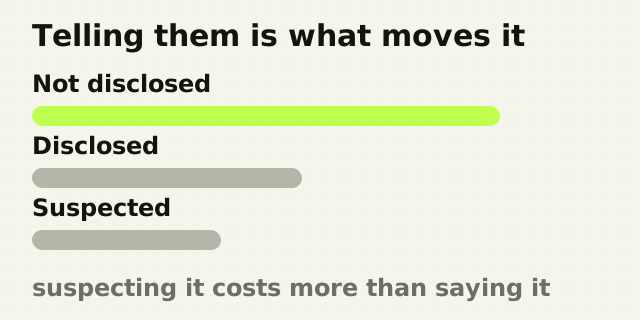
The most operationally important observation in NN/g's write-up is not about the AI images at all. It is that when participants suspected an image was AI-generated, they reacted negatively, including toward genuine photographs they had misidentified.
Read that again. The penalty attaches to the suspicion, not to the fact.
This inverts how most teams are approaching the question. The risk is not whether people will find out your images are AI. The risk is whether your imagery trips the detector, and that detector is getting more sensitive every quarter while producing false positives against real photography. A team that shoots an expensive original campaign can still eat the penalty if the results look synthetic. The same instinct now reads interfaces as well as images, which is why the visual tells of AI-generated design have turned into their own category of brand risk.
The disclosure question the study does not answer
NN/g is explicit that the results describe a scenario where the source is unknown, and do not describe what happens when AI use is disclosed. That boundary matters, because the disclosed condition looks very different in other research.
A 2026 survey of just over a thousand US consumers found 39% saying that heavy AI use in a brand's marketing would reduce their trust in that brand, roughly double the 20% who said the same a year earlier, with the effect strongest among Gen Z at 54%. The same body of research shows around 90% of consumers saying they want AI-generated images labelled, while only about a fifth of organisations always disclose and a third never do.
So the two findings sit together like this: undisclosed AI imagery carries no measurable penalty in a controlled test, disclosed AI imagery carries a real one in the market, and consumer expectation of disclosure is close to universal. That is not a comfortable position, and pretending the first finding cancels the other two is how teams end up in trouble.
The legal layer is no longer theoretical
Two things changed the calculus in 2026. The EU AI Act's transparency obligations apply from August 2026, with penalties in serious cases reaching a percentage of global turnover. In the US, undisclosed AI in advertising can be treated as a deceptive practice under Section 5 of the FTC Act, with per-violation civil penalties in the low tens of thousands of dollars, and several states have added their own disclosure rules.
The training-data question is also unresolved rather than settled. Getty's litigation against Stability AI produced a mixed UK outcome, with Getty largely unsuccessful on copyright while succeeding on a narrower trademark point, and the US case surviving a motion to dismiss in April 2026. Meanwhile Getty has licensed its library to OpenAI. The direction of travel is toward licensed training data being a commercial differentiator, not toward the question disappearing.
NN/g's own recommendations point the same way: evaluate each image individually, check representation and diversity, screen for technical errors, and consider the consent and licensing implications of the training data behind the generator.
A policy that survives both findings
- Judge the image, not the pipeline. The research says quality is what moves ratings. A bad AI image and a bad stock photo fail identically.
- Set a does-this-look-synthetic review gate. Hands, text, reflections, teeth, jewellery, plausible-but-wrong architecture. The suspicion penalty is the real risk, so review for tells even in real photography.
- Disclose, and disclose early. Roughly nine in ten consumers expect it, regulators increasingly require it, and disclosure discovered later is materially worse than disclosure offered upfront.
- Never generate what should be documentary: real people, real premises, real products, real customers, real credentials.
- Check representation deliberately. Generators reproduce the skew of their training data, and that skew becomes your brand's implicit statement.
- Use a generator with defensible training provenance and keep a record of what was generated where.
- Do not generalise from a consulting-firm hero image. NN/g tested one narrow case well. Your context is probably not that case.
The point
The useful takeaway from NN/g's study is not that AI images are fine. It is that in a blind ten-second judgement, image quality mattered and provenance did not. That is a finding about human perception under specific conditions, and it is genuinely interesting.
But you do not ship into blind conditions. You ship into a market where a growing share of your audience is actively scanning for synthetic content, expects to be told, and increasingly has regulators on their side. The image that passes the lab test can still fail the room. The same gap between a controlled result and a real one shows up in how teams test their own software, and the same problem is now arriving in interface design, where polished generated output makes design judgment harder and more valuable at once.
Use the tools. Say that you used them. The research suggests the work itself will hold up. Deciding where generated imagery fits against your own brand is the kind of call I work through in a design engagement, and you can see the work it applies to here.
Frequently asked questions
- Are AI-generated images bad for a website?
- Not inherently. NN/g's 2026 study found AI hero images rated as well as stock photography on trust and professionalism when participants did not know the source, and slightly higher on authenticity. Image quality predicted the ratings, not origin. The risk sits in disclosure and in whether the image looks synthetic, rather than in how it was made.
- Do I need to disclose that images are AI-generated?
- Increasingly, yes. The EU AI Act's transparency obligations apply from August 2026, and in the US undisclosed AI in advertising can be treated as a deceptive practice under Section 5 of the FTC Act. Around 90% of consumers say they want AI images labelled, so disclosure discovered later is far more damaging than disclosure offered upfront.
- Can people tell if an image is AI-generated?
- Often not, but suspicion matters more than accuracy. NN/g found participants reacted negatively when they believed an image was AI-generated, including toward genuine photographs they had misidentified. The practical implication is that any image which looks synthetic carries a penalty, whether or not it actually is.
- Is AI-generated imagery copyright-safe?
- Not settled. Getty's case against Stability AI produced a mixed UK ruling, largely unsuccessful on copyright but succeeding on a narrower trademark point, while the US case survived a motion to dismiss in April 2026. Getty has separately licensed its library to OpenAI. Choose generators with defensible training provenance and keep records of what you generated.
- When should I use stock photography instead of AI images?
- Whenever the image makes a documentary claim. Real people, actual premises, genuine products, customers and credentials should never be generated, regardless of labelling, because a synthetic image in those slots is a misrepresentation. Generic conceptual and workplace scenes are where the NN/g findings apply.
Sources
This thinking, applied
Share this