The price of competence is collapsing
There is a category of design work that used to take a surprising amount of time. Generating layout options. Producing component variants. Adapting a page to four breakpoints. Rewriting a hero headline twenty ways. Turning a design system into working front-end code.
That work is not gone. It is becoming cheap.
The 2026 Stanford AI Index reports that 88 per cent of surveyed organisations were using AI, with generative AI in at least one business function at 70 per cent. Field research with BCG consultants found that GPT-4 made people more than 25 per cent faster and improved human-rated performance by more than 40 per cent on tasks inside the model's capability frontier. An NBER study of customer support found a 14 per cent average productivity gain, concentrated among less experienced workers.
Those numbers describe what happens when a tool absorbs repeatable patterns. The gap between someone who has never built a pricing page and someone who has built twenty narrows sharply when the first person can summon twenty references, generate a responsive scaffold and get a critique of their hierarchy in one afternoon.
That is good. Product teams should want competent execution to get cheaper.
But competent and distinctive are not synonyms.
AI raises the floor before it raises the ceiling
The useful creativity research is not the work asking whether AI is creative. That question is too blunt. The better one is what happens to the distribution of ideas when many people use the same models.
A 2024 paper in Nature Human Behaviour found that ChatGPT improved the creativity of ideas people produced across several tasks. A 2025 follow-up made the trade-off explicit: AI-assisted ideas could be better individually while becoming less diverse collectively.
The floor rises first. The centre gets crowded at the same time, and the crowd is made of good work.
Fewer pages are catastrophically bad now. Spacing is cleaner. Components align. Empty states exist. Copy is grammatical. Accessibility mistakes are easier to catch.
And if everyone asks a similar model to design a premium AI SaaS landing page, everyone starts from a similar cloud of priors: dark hero, electric gradient, rounded cards, bento grid, floating screenshot, eyebrow label, grayscale logo row. The prompt can be different while the prior is the same.
The result is not bad design. That is the problem. It is good-enough design that could belong to anybody.
The scarce work moves upstream
When execution becomes abundant, value moves to the decisions that constrain execution. I would separate modern design value into four layers.
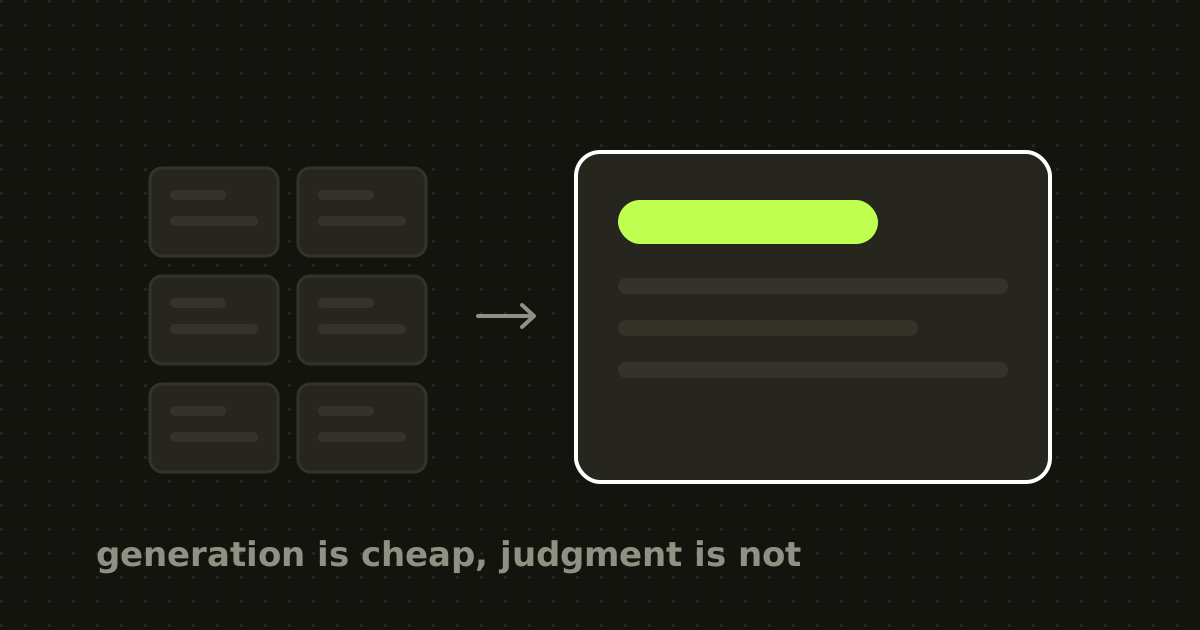
- Generation. Producing options, layouts, copy, components and code. 2. Selection. Knowing which options deserve to survive. 3. System. Turning the chosen direction into repeatable rules rather than isolated screens. 4. Judgment. Deciding which problem is worth solving, what evidence is sufficient, where convention should win, and where differentiation is worth its usability cost.
AI is already excellent at layer one, and becoming useful at layer three when a design system gives it enough context. Layers two and four are where seniority becomes visible.
A senior designer's output is often a smaller set of options, not a larger one. The value sits in what never reaches the review: the six concepts rejected for overstating the product, the chart removed because it answers no decision, the clever interaction killed because a table is faster, the unique navigation abandoned because buyers already know where Pricing lives.
That work is difficult to screenshot. It is also what prevents expensive mistakes.
Distinctiveness is not decoration
There is a dangerous version of this argument where AI makes generic design, therefore humans should make strange design. The evidence does not support it.
Google research on website aesthetics found that low visual complexity and high prototypicality, meaning designs that look recognisably like the kind of site a user expects, tend to be judged more positively, and that those judgments form extremely quickly. Familiarity is useful. Convention carries information for free, which is the same reason Hick's law rewards grouping rather than deletion.
Distinctiveness works when it is spent on the parts of the experience where memory and positioning live, without making routine interaction harder.
For a B2B SaaS product I would keep navigation labels, form controls, pricing mechanics, common dashboard interactions, billing conventions and accessibility behaviours familiar. I would look for differentiation in the product story, art direction, motion language, data storytelling, hero composition, the demonstration of the core mechanism, and typographic rhythm.
A competitor should be able to copy your button component and gain almost nothing. If they can copy your entire site by swapping the logo, you did not build a visual language. You assembled a category template.
So should designers charge more because AI exists?
Not automatically. If AI lets a designer deliver the same thinking in fewer hours, charging more purely because the tool made them faster is hard to defend. Clients do not owe a productivity tax.
The stronger case is that the unit being sold changes. An experienced designer should increasingly price for risk removed before engineering, strategic clarity, speed to a validated direction, distinctiveness that fits the category, and a system that scales those decisions rather than a set of screens.
That can justify a higher project fee even when the project takes fewer hours. The buyer is not paying for more time in Figma. They are paying for a shorter path to a better decision.
There is a reason not to get carried away. The same tools that raise a good designer's leverage make it easier for clients to spot performative complexity. If the deliverable is still three homepage concepts and a moodboard, the market will price that down. Senior pricing survives only when senior judgment is visible in the work.
A test: are you selling execution or decision quality?
Take your last engagement and remove every artefact a competent AI tool could now produce in a first pass. Wireframes. Component variants. Headline options. Responsive adaptations. First-draft documentation. Basic prototypes.
What remains?
If the answer is not much, the role is exposed. If what remains is a clear problem definition, a research decision, a strong information architecture, a product model, explicit trade-offs, a differentiated visual principle and a system that scales those decisions, then AI is not replacing the value. It is clearing low-leverage work away from it.
What I would ask if I were buying design now
Do not ask a designer whether they use AI. Assume they do. Ask these instead.
- What did you decide not to build in your last project, and why? 2. Show me a screen where you deliberately followed convention rather than making it unique. 3. Show me a place where the brand became distinctive without adding interaction cost. 4. What evidence would make you reverse your preferred direction? 5. How does your design system constrain AI-generated pages so the product does not drift? 6. Which part of this engagement should get cheaper because AI exists?
The last one matters most. A designer confident in their value can tell you where automation reduces cost, not only where it increases price.
The point
AI is not making design uniformly cheaper. It is separating the work into commodities and scarce decisions.
The commodity is competent generation. The scarce part is taste grounded in context, selection grounded in evidence, and judgment grounded in the cost of being wrong.
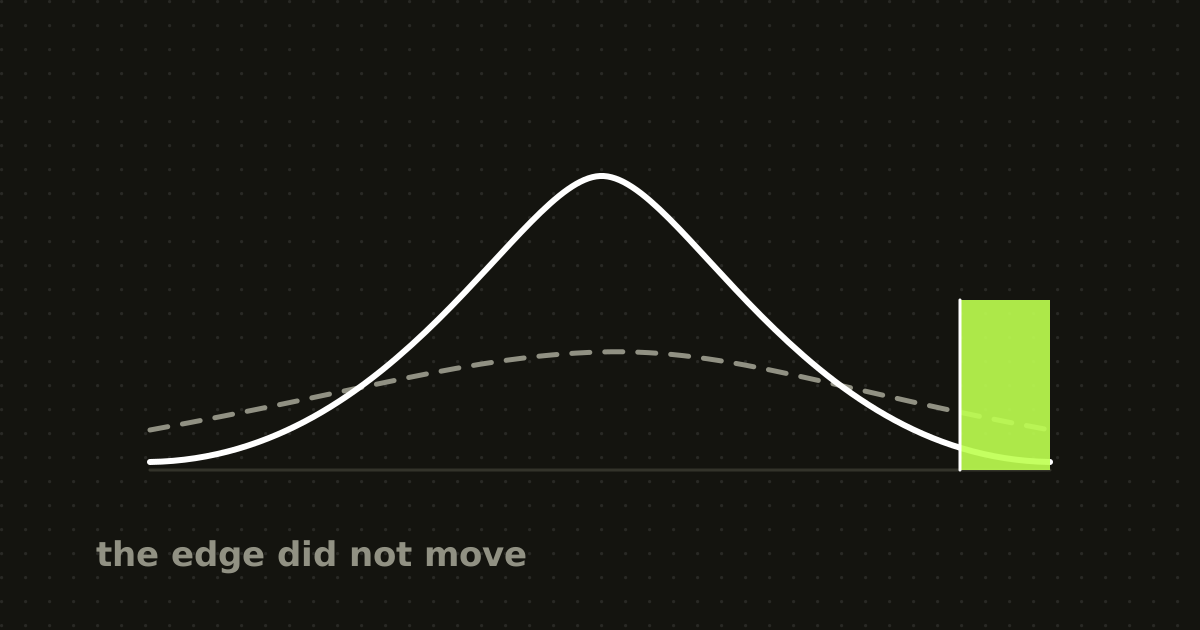
That is why a market flooded with acceptable design can make genuinely specific design feel more valuable rather than less. The more easily everyone reaches the middle, the more obvious the edges become.
Frequently asked questions
- Is AI replacing product designers?
- It is replacing a portion of the work rather than the role. Generation of layouts, variants, copy options and front-end scaffolding is becoming cheap. Deciding which problem to solve, which option survives, what evidence is sufficient and what the product should not do has not become cheaper, and those decisions determine whether the generated work was worth producing at all.
- Does AI make design work less valuable?
- It makes competent execution less valuable and distinctive judgment more valuable. Research on creativity support finds that AI can raise the average quality of individual ideas while reducing diversity across a group. When everyone can reach a good average easily, the commercial advantage moves to the decisions that produce something specific rather than merely acceptable.
- Should a design agency charge more because it uses AI?
- Not for the tool itself. Charging more purely because software made the work faster is difficult to justify to a buyer. The defensible case is that the unit being sold changes from hours of execution to risk removed, strategic clarity and a system that scales decisions, which can support a higher project fee even when the project takes less time.
- How do you keep a product distinctive when everyone uses the same AI tools?
- Spend the originality budget where memory lives rather than where users work. Keep navigation, forms, pricing mechanics and common controls conventional, because familiarity reduces the effort of using the product. Differentiate the product story, art direction, motion, data storytelling and the demonstration of your core mechanism, which a competitor cannot borrow without the mismatch becoming obvious.
Sources
- Stanford HAI, The 2026 AI Index Report, Economy chapter
- Dell'Acqua et al., Navigating the Jagged Technological Frontier, Harvard Business School and BCG
- Brynjolfsson, Li and Raymond, Generative AI at Work, NBER
- Meincke, Nave and Terwiesch, ChatGPT decreases idea diversity in brainstorming, Nature Human Behaviour
- Tuch et al., Visual complexity and prototypicality in first impressions of websites, Google Research
This thinking, applied
Share this