A different question from "do we need a redesign"
Whether your SaaS website needs a redesign at all is a diagnostic question, and it has its own five-layer answer.
This is the next question. Assume the answer was yes. What positioning work has to be finished before the design team starts turning strategic disagreement into expensive revision rounds?
That sequencing problem is where most redesign budgets actually go.
Positioning is not the headline
Positioning is not the tagline, the brand voice or the page copy. Those are expressions of it.
April Dunford's framework starts with market context: what buyers would do if your product did not exist, what unique capabilities you have relative to those alternatives, the value those capabilities create, which customers care most, and what category makes the value obvious.
That sequence matters because a sentence can sound excellent while the underlying choices are unresolved. "The AI operating system for modern finance teams" is concise and tells me almost nothing if the team has not agreed whether the product replaces a spreadsheet workflow, competes with an accounts-payable suite, augments an ERP, or creates a new category.
How fuzzy positioning leaks into design
You can spot a positioning problem inside a design review, because feedback arrives in the wrong vocabulary.
Can we make the hero more enterprise. This feels too focused on finance, operations uses us too. We need all six modules above the fold. The illustration does not communicate everything the platform can do. Can it look more innovative.
Those sound visual. Most are strategic.
The team is trying to resolve buyer priority, category and scope through layout. Each alternative the designer produces encodes a different company.
That is why round two becomes a debate about who the homepage is for rather than whether the composition works.
The positioning-readiness pack
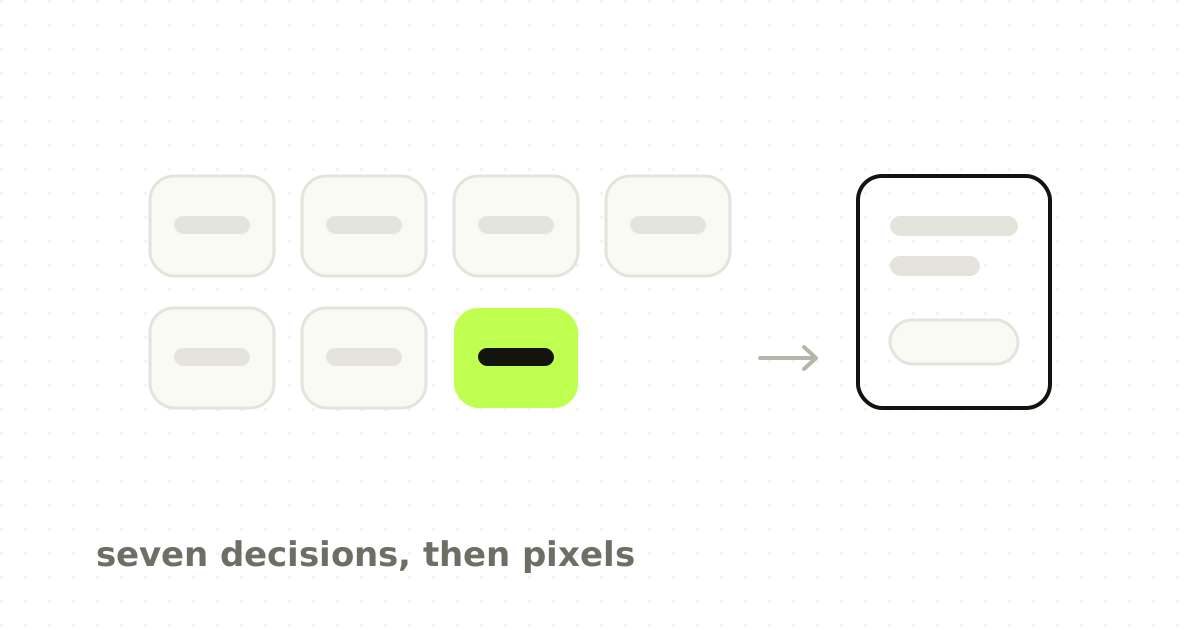
Before kickoff I would want seven decisions written on one or two pages. Not a fifty-slide brand deck. A working contract the team can point at when feedback drifts.
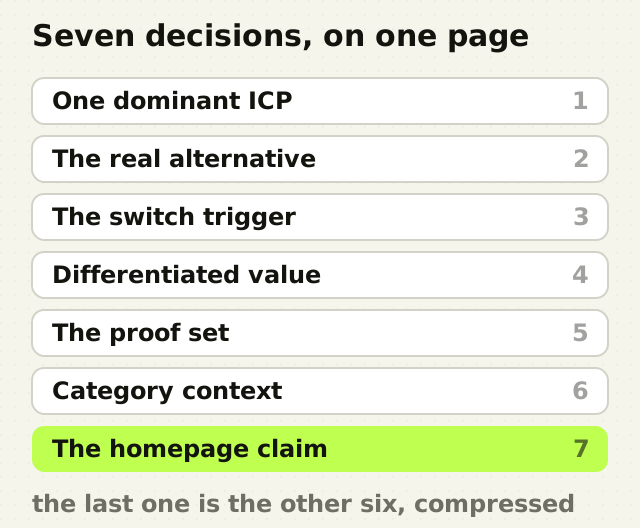
1. One dominant ICP. Name the buyer and the company condition that makes the problem urgent. "Mid-market SaaS" is a market slice. "Finance operations leaders at multi-entity SaaS companies closing books across five or more entities with a small team" is closer to designable. Secondary users can exist; they should not all get equal homepage priority unless you will maintain separate narratives.
2. The real competitive alternative. Write what the best-fit buyer would do without you. A spreadsheet, a manual process, an ERP module, a named incumbent, an internal tool. This determines the contrast the site must create. If sales thinks the competitor is doing nothing while product thinks it is a category leader, the homepage will wobble between urgency and feature comparison. Naming an incumbent is its own decision with its own risks.
3. The switch trigger. What changed in the buyer's world that makes the old alternative unacceptable now? Volume crossed a threshold. Regulation changed. Headcount stopped scaling. An error became expensive. The trigger is what turns generic pain into a purchase window.
4. Differentiated value, not a feature inventory. A capability matters only relative to an alternative and a buyer. Real-time reconciliation is a capability. Closing with fewer manual exception reviews because matching happens continuously instead of at month end begins to express value. The design team needs this because visual hierarchy follows value hierarchy. If every feature is equally important, every section becomes equally loud.
5. The proof set. List the strongest evidence you can legally and honestly publish: named customers, outcomes, implementation time, security credentials, integration coverage, product mechanics, usage scale. Do this before wireframes, or the designer creates attractive proof placeholders and discovers in week three that the logos are not cleared and the metric cannot be substantiated.
6. Category context. Decide whether to place the product inside a category buyers already understand or teach a new frame. Existing-category positioning lowers comprehension cost and invites familiar comparison. New-category positioning improves differentiation and demands more education and proof. That is a strategic trade-off, not a copywriter's choice on launch day.
7. The homepage claim. Compress the positioning into the simplest version a cold visitor needs to decide whether to continue. It does not need to close the deal. It needs the right buyer to think this is for a problem I have, and this approach is worth understanding. The sales conversation can carry the nuance; the homepage cannot improvise based on who is reading.
Three inputs to audit before writing the claim
Pull ten recent sales calls across wins, losses and no-decisions. What problem did buyers believe they were solving? Which alternatives did they mention? Which phrase made them lean in? What did the rep explain repeatedly because the website did not?
Read onboarding notes, support tickets, reviews and renewal conversations. The goal is not to copy customer wording mechanically. It is to find the vocabulary buyers use before they learn your internal language.
Then compare the current homepage to the current sales story. If the site leads with all-in-one platform while sales wins by describing one painful workflow, the website is carrying an older version of the company.
Four cheap tests before the design sprint
- Team alignment. Ask the founder, sales lead, product lead and marketing lead separately who the primary buyer is, what problem they are buying you to solve, and what they would do without you. Compare answers without editing them into agreement. If you get four companies, do not open Figma. 2. Stranger comprehension. Show the hero to someone outside the company with the logo removed. Ask what it sells, who it is for and what changes. Not a conversion study, just a cheap diagnostic for whether internal knowledge is doing too much work. 3. Competitive alternative. Show the positioning statement without the product name and ask sales whether it explains why a buyer should move from the alternative they actually see in deals. 4. Proof readiness. Attach evidence to every major promise. If a claim has no proof, lower the claim, find evidence, or decide the design must demonstrate the mechanism directly.
What design can finally do
Once these are locked, design improves because the team stops asking the interface to solve strategy.
Information architecture can prioritise the buyer's questions. The hero can make one claim. Proof can appear in the order scepticism develops. Art direction can express a specific market position rather than premium tech. The component system can be built around the page types the go-to-market team actually needs.
Even visual differentiation gets easier. A company that knows what it stands against can choose which category conventions to keep and which signals to reject.
Positioning is not permanently done
There is a bad version of this advice where teams spend three months perfecting a strategy document before publishing anything.
Positioning is a market hypothesis. It should be specific enough to design against and test, then updated as evidence changes. The point is to avoid building an expensive visual system around a story the team already knows is unresolved.
A pre-product-market-fit company should keep the system cheap to change. A company with a repeated sales story can invest more deeply, because the underlying decisions have earned stability.
The point
A website redesign is too expensive a place to discover what company you are.
Fix the positioning until the design team receives constraints worth amplifying: one buyer, one market context, one reason to switch, a clear value hierarchy and evidence.
Then design can do what it is good at, which is making the truth easier to see.
Frequently asked questions
- What positioning work should happen before a website redesign?
- Seven decisions: one dominant ICP, the real competitive alternative, the switch trigger, the differentiated value, the proof set, the category context and the single homepage claim. Written on one or two pages, they become a contract the team can point at when design feedback starts drifting into strategic disagreement.
- How do I know my positioning is too vague for design?
- Ask the founder, sales lead, product lead and marketing lead separately who the primary buyer is and what they would do without you, then compare the answers unedited. If you get several different companies, the ambiguity will surface as design feedback instead, phrased as requests to make the hero more enterprise or fit another audience in.
- Is positioning the same as a tagline?
- No. A tagline is one expression of positioning. Positioning is the set of decisions underneath it: which alternatives buyers compare you against, which capabilities differ, what value those create, which customers care most, and what category makes the value understandable. A concise tagline can sit on top of choices nobody has actually made.
- How long should positioning work take before a redesign?
- Long enough to write the seven decisions and test them cheaply, usually a week or two rather than a quarter. Positioning is a hypothesis to design against and update, not a document to perfect. The failure to avoid is committing an expensive visual system to a story the team already knows is unresolved.
Sources
This thinking, applied
Share this