The usual answer is "earlier than you did"
Ask founders when they should have hired their first product designer and most say earlier. Ask why they did not and the answers are familiar: the product was still changing, engineers could handle the interface, there was no budget for a role that did not ship code.
All of those are reasonable, and all of them hide the same fact. Every product is designed. When nobody is responsible for the design, it gets decided anyway, one pull request at a time, by whoever is building that screen that week. The question of when to hire a product designer is really a question about when that default stops being good enough.
Signs the product is being designed by default
- Flow decisions are made in code review. Someone asks "should this be a modal or a page?" in a pull request, and the answer is whatever is quickest.
- The same pattern exists three ways. Three kinds of table, two filtering models, several empty states, each reasonable where it was built.
- Customers are confused by screens nobody planned. Support tickets ask how to do things the team thought were obvious.
- Sales demos avoid parts of the product. The team knows which screens do not show well and routes around them.
- The product has moved upmarket and the interface has not. Larger customers bring roles, permissions and admin needs the original design never considered.
One of these is normal. Three means the product has outgrown the default.
Three shapes of design help
Hiring the first product designer does not have to mean a full-time role on day one. There are three shapes, and each fits a different stage.
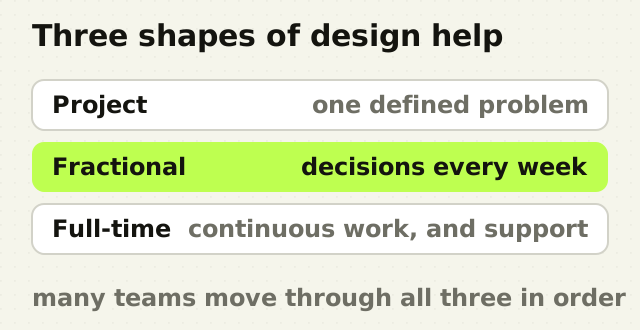
- A project, such as a design sprint or an audit. Right when there is one defined problem: the onboarding flow, a new feature, a first version. It ends in something built and a decision log, and it does not require an ongoing commitment.
- A fractional designer, a few days a week. Right when design decisions are needed every week but not forty hours of them. The designer joins the planning cycle, owns the decisions and writes down the patterns as they emerge.
- A full-time hire. Right when there is enough continuous design work across the product to fill a role, and someone in the company can manage and support a designer.
Many teams go through all three in order. A project shows what good design does for the product, fractional work keeps it going, and the full-time hire takes over a product that already has its patterns written down.
What the first designer has to be good at
The first product designer at a startup cannot be a specialist. Andy Budd calls this role the founding designer: a fast, product-minded generalist who can turn vague ideas and half-built code into something users understand. In practice that means being able to run a small piece of research, structure information before drawing screens, design the real states and not just the happy path, and hand over work engineers can build without guessing.
Front-end literacy helps more than it is usually given credit for. A designer who understands what a design costs to build makes decisions engineers trust, which matters when there is one of them and a whole engineering team.
How to tell if you are ready for full-time
A full-time designer needs three things to succeed: enough design work to fill the week, someone senior enough to argue product decisions with, and a team willing to change plans based on what the designer finds.

If one of those is missing, a full-time hire tends to become a production role, making screens for decisions already taken. That is an expensive way to use a senior designer and a fast way to lose one. A fractional arrangement is often the better bridge, and a good one should end by helping scope and hire the full-time role.
Interview for judgement, not a portfolio
Portfolios show finished screens, and finished screens say little about how someone decides. In the interview, ask the candidate to walk through one project: what the problem was, what they found, which options they rejected and why, and what they would do differently. Then give them a small, real problem from your product and ask how they would approach it, not what they would draw.
Designer Fund's guide for founders and Unusual Ventures' field guide on hiring designers both make versions of the same point: the first designer shapes how the whole company makes product decisions, so hire for how they think, not only for how their work looks.
The point
The first product designer is not a luxury to add once the product works. It is the moment design stops being whatever the last pull request decided. Match the shape of help to your stage: a project for one problem, a fractional designer for ongoing decisions, a full-time hire when there is enough continuous work and support for one.
If you are between those stages, the tender platform I designed surface by surface and my notes on how I work with teams show what the middle option looks like in practice.
Frequently asked questions
- When should a startup hire its first product designer?
- A startup should bring in its first product designer when design decisions are being made by default: flows decided in code review, the same pattern built several ways, customers confused by unplanned screens, or the product moving upmarket without the interface following. That help can start as a project or a fractional designer before becoming a full-time hire.
- Should a startup's first designer be full-time?
- Not necessarily. A full-time designer needs enough continuous work, a senior person to argue product decisions with, and a team willing to act on design findings. Without those, a project or a fractional designer working a few days a week is often a better fit, and can help scope the full-time role later.
- What is a founding designer?
- A founding designer is the first product designer at a startup, usually a generalist rather than a specialist. The role covers light research, information architecture, interaction and visual design, and handoff to engineering. Andy Budd describes it as a fast, product-minded generalist who can turn vague ideas and half-built code into something users understand.
- What is a fractional product designer?
- A fractional product designer is a senior designer who works with a company part-time, typically two or three days a week on a rolling basis. They join the existing planning cycle, own design decisions and document patterns. It suits companies that need design decisions every week but not a full-time role yet.
- What should I look for when hiring a first product designer?
- Look for judgement over polish. Ask candidates to walk through how they decided on a past project: the problem, the evidence, the options they rejected and why. Give them a small, real problem from your product and ask how they would approach it. Breadth, front-end literacy and the ability to work without a design team matter most.
Sources
This thinking, applied
Share this