

The day the market priced in the end of the seat
On 3 February 2026, investors decided that a set of plugins could end a business model. Anthropic had released industry plugins for Claude Cowork a few days earlier, including one that reviews contracts and triages NDAs. That Tuesday, Thomson Reuters fell 15.83 percent, its largest one-day drop on record, LegalZoom fell 19.68 percent, and Bloomberg counted a $285 billion rout across software, financial services and asset-management stocks.
The fear had a nickname, the SaaSpocalypse, and a simple logic. If an agent can do the work a person used to do inside a piece of software, the customer needs fewer people, and a vendor that charges per person sells fewer seats. That is the idea behind agentic AI as a service: businesses paying for AI agents that complete work, rather than for software licences that people operate.
Speaking at a Cisco event the same day, Nvidia's Jensen Huang called the fear that AI would replace software companies "the most illogical thing in the world". In the third quarter the IGV software index rose about 17 percent while chip stocks fell.
Both reactions miss what is actually changing. SaaS is not dying. The seat is, or more precisely, the seat as the thing a customer believes it is paying for. What follows is the evidence from 2024 to 2026, and what it means for the people who design and build software.
How SaaS turned software into a subscription
Salesforce opened its doors in 1999 selling CRM through a web browser, under a logo with the word "software" crossed out. Companies would stop installing and maintaining software and rent it instead, always updated, paid for monthly, per user.
Per-seat pricing worked because it tied the price to something a buyer could count and a vendor could forecast. A seat was easy to budget and easy to sell team by team, and it grew on its own. When a customer hired, the vendor's revenue grew with it. Recurring revenue made SaaS companies predictable, and investors paid a premium for predictability.
The product followed the pricing. If revenue scales with users, the product's job is to make each user productive inside it, with dashboards to watch, workflows to step through and features to adopt. The value lived in the tool, and a person operated it.
That arrangement carried a quiet assumption, that value grows with the number of people logged in. It was never exact. Zylo's 2026 SaaS Management Index, drawn from more than 40 million licences, found that 36 percent of licences go unused on average. A seat always measured access, not work. For twenty-five years that barely mattered, because the work could only be done by the people in the seats.
Why per-seat SaaS is under pressure
Agents break that link. When software does part of the work itself, a customer can get more done with fewer people, and a vendor that bills per person is punished for its own product getting better.
Salesforce shows both sides of this. In September 2025 Marc Benioff said Salesforce had cut its support organisation from about 9,000 people to about 5,000 as AI agents took on more of the work. Any support team that makes the same move on a seat-priced helpdesk buys fewer seats.
Gartner has put a number on the exposure. In July 2026 it said up to $234 billion of enterprise application software spending is at risk from "agentic arbitrage" by 2030, about a fifth of application SaaS spend, because agents weaken the link between user growth and vendor revenue. That is a forecast of exposure, not of lost revenue, but the mechanism it describes is the one investors panicked about in February.
Three other forces push the same way. Building is cheaper: in McKinsey's State of AI 2026 survey, 32 percent of respondents said their organisation had decided against buying at least one software product or feature because it could be built internally with agentic coding tools.
AI-native companies grow faster, and many were never priced by seat. Stripe found that the top 100 AI companies on its platform reached $1 million in annualised revenue in a median of 11.5 months, about four months faster than the fastest-growing SaaS companies of the subscription boom.
And buyers are starting to expect results rather than assistance. Gartner predicts that by 2028 more than half of enterprises will stop paying for assistive AI such as copilots, in favour of platforms that commit to workflow results. That is a prediction. The measured picture is earlier: Gartner's 2026 CIO survey found that only 17 percent of organisations had deployed AI agents at all.
From software you operate to agentic AI as a service
The shift is easiest to see as four steps, each one changing who does the work.
- Software as a service: a person does the work inside a tool.
- AI-powered SaaS: the tool suggests, drafts and summarises, and the person still acts.
- Agentic AI: the software plans and carries out multi-step work across systems, within limits a person sets.
- Agent-as-a-service: the agent's finished work is what the customer buys, and often what it is billed on.
Anthropic draws the technical line clearly. In its guide to building effective agents, workflows "are systems where LLMs and tools are orchestrated through predefined code paths," while agents "are systems where LLMs dynamically direct their own processes and tool usage, maintaining control over how they accomplish tasks." An assistant answers. An agent decides what to do next, and does it.
Take one support request: a customer writes in about a damaged order and wants a refund. In a traditional helpdesk, a person reads the ticket, finds the order, checks the refund policy, issues the refund in the payment system, updates the CRM and replies. That is six steps across several systems, all done from one seat. With an AI assistant, the person gets a suggested reply and the right paragraph of policy, and still does all six steps.
An agent does the steps itself. It reads the request, finds the order, checks the policy, issues the refund, updates the record, replies and logs each action. When the refund is above the limit it was given, it prepares the change and hands it to a person to approve.
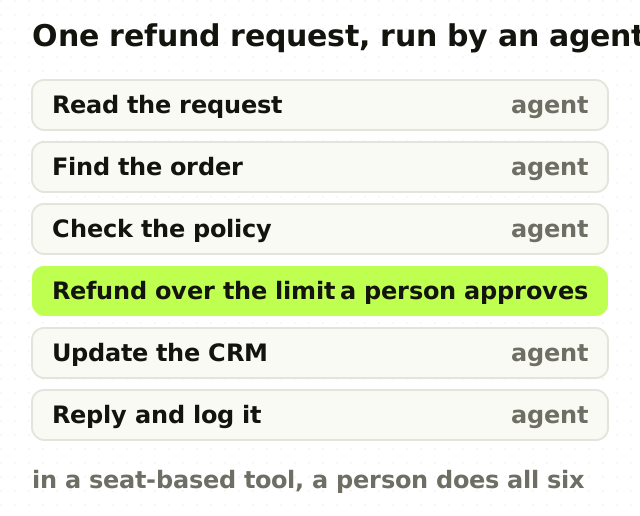
That handover is the difference between a demo and a product. An agent that can move money needs scoped permissions (which systems it may write to, and up to what amount), oversight for actions that cannot be undone, and evidence that it behaves the same way twice. That evidence is still thin. When Sierra published its τ-bench benchmark in 2024, the best function-calling agents succeeded on fewer than half of the tasks, and passed the same retail task in all eight attempts less than 25 percent of the time. Salesforce's CRMArena-Pro found leading agents succeeding about 58 percent of the time on single-turn business tasks and about 35 percent on multi-turn ones. Models have improved since both papers, but consistency, not capability, is what an agent sold on outcomes has to guarantee.
When I designed Fincline, a payment reconciliation product for bookkeepers, the founders and I settled this early. The software matches payments to invoices on its own, but nothing posts to the books until a person confirms. That rule became the product's argument for itself, because it told a bookkeeper exactly where the software's work ended and their accountability began.
SaaS vs agent-as-a-service, side by side
The table compares the two models in their pure forms. Real products mix them, and the mix is where most of the interesting decisions sit.
| Aspect | Traditional SaaS | Agent-as-a-service |
|---|---|---|
| What you pay for | Access: a seat per person, per month, on a plan tier | Work: per resolution, task, action or credit, often on top of a platform fee |
| How people use it | They operate the software, screen by screen | They delegate a goal, then review, approve or correct the result |
| Who moves the work | A person, between tools and tabs | The agent, across connected systems, inside its permissions |
| Automation | Rules configured in advance for known cases | A plan made per request, within limits set in advance |
| Value proposition | A better tool for the team | A finished piece of work |
| Where people stay involved | In every step | At exceptions, approvals and audits |
| What it scales with | Headcount | Volume of work |
| How success is measured | Adoption and seats renewed | Tasks completed correctly, and what each one cost |
Most products in 2026 sit between the columns: a platform priced by seat, with agent work metered on top.
Mixing is the norm, not the exception. In billing company Orb's 2026 sample of 80 AI agent companies, 91 percent metered usage in some form, 71 percent kept a subscription component, and fewer than 4 percent priced purely on outcomes. The seat is not being replaced by one new model. It is being joined by a meter.
What CEOs are saying, and where they disagree
The loudest voices agree that agents matter. They disagree about what happens to the software underneath.
Microsoft's Satya Nadella made the strongest case for disruption on the BG2 podcast in December 2024. Business applications, he argued, are "essentially CRUD databases with a bunch of business logic," and "the business logic is all going to these agents." His conclusion: "The notion that business applications exist, that's probably where they'll all collapse, right, in the agent era." He was describing Microsoft's own Dynamics business as much as anyone else's.
Nvidia's Jensen Huang treats agents as labour that software has to manage. At CES 2025 he said "The IT department of every company is going to be the HR department of AI agents in the future." At GTC in March 2026 he described SaaS companies becoming "agentic as a service" companies. Yet he rejects the idea that agents replace software. His argument in February was that an intelligent agent would use existing tools rather than reinvent them, and after the selloff he told CNBC, "I think the markets got it wrong."
Salesforce's Marc Benioff frames agents as workers. In February 2025 he said "we are the last generation to manage only humans," and Salesforce has marketed Agentforce as a "digital labor platform." Box's Aaron Levie puts the software-demand case most directly: "Agents will be the biggest users of software."
Andrej Karpathy supplies the timeline check. Pushing back on talk of "the year of agents," he told the Dwarkesh Podcast in October 2025 that this is "more accurately described as the decade of agents," because today's agents cannot yet do an employee's job, even though he uses them daily.
Read together, the disagreement is narrower than the headlines. Nadella is talking about where business logic lives, Huang and Levie about how much software gets used, Benioff about what customers will pay for, and Karpathy about when. All of them can be right at once, which is roughly what the products being shipped suggest.
What Salesforce, Microsoft and AI-native startups are building
Products tell you more than keynotes, because each one has to pick a price.
Salesforce has used four pricing models for agents in under two years. Agentforce launched in September 2024 at $2 per conversation. In May 2025 it added Flex Credits at $0.10 per action, alongside per-user add-ons. By late 2025 it was also selling fixed-fee enterprise agreements, and its revenue chief, Miguel Milano, told The Register that "a lot of customers want seat-based because seat-based gives you the predictability." In 2026 it launched a service agent that only charges for resolutions. The business is real and still small: Agentforce passed $1.5 billion in annual recurring revenue in August 2026, on a newly broadened definition, against full-year revenue guidance above $46 billion.
Customer support is where outcome pricing has gone furthest, because a resolved ticket is easy to count. Intercom priced its Fin agent at $0.99 per resolution. In May 2026 the company renamed itself Fin, and in June Salesforce signed an agreement to acquire it for about $3.6 billion. Zendesk has charged per automated resolution since 2024, and its chief executive, Tom Eggemeier, told a conference audience this year, "Unequivocally: seats are dead." Sierra, the agent company led by Bret Taylor, has sold on outcome-based pricing from the start and reached $100 million in annual recurring revenue in under two years.
The platform giants are betting on governance. Microsoft is also keeping the seat: Microsoft 365 Copilot has been $30 per user per month since 2023. Agent 365, Microsoft's control plane for registering, securing and monitoring agents from any vendor, became generally available in May 2026 at $15 per user per month: per human, not per agent. ServiceNow's AI Control Tower makes the same bet from the IT side, governing agents it did not build as well as its own. OpenAI's Frontier platform, launched in February 2026, gives each "AI coworker" its own identity and permissions.
Underneath, the plumbing is being standardised in the open. Anthropic's Model Context Protocol, released in November 2024 to connect models to business systems, became a founding project of the Linux Foundation's Agentic AI Foundation in December 2025, alongside OpenAI's AGENTS.md and Block's goose. Google's Agent2Agent protocol, which lets agents from different vendors work together, joined it in August 2026.
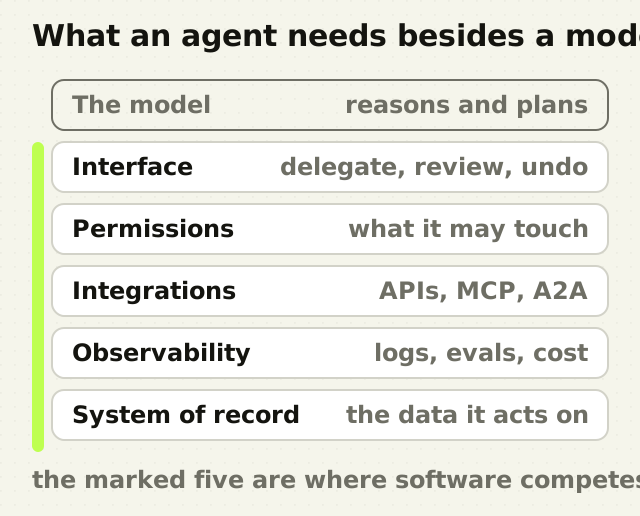
The pattern is consistent. Once integration is an open standard, it stops being a moat. What the large vendors are competing for is the layer that decides what agents are allowed to do, and the record of what they did.
The new economics of agentic AI as a service
Every pricing model is a bet about who carries the risk. Per-seat pricing puts it on the customer, who pays whether the software helps or not. Outcome pricing puts it on the vendor, who absorbs the cost of every failed attempt. Usage pricing splits it, and hybrid pricing, a platform fee plus metered work, splits it in a way a finance team can budget.
That is why hybrid keeps winning in practice. Bessemer's AI pricing and monetization playbook recommends hybrid models when value is uncertain, and notes that AI companies often run 50 to 60 percent gross margins against 80 to 90 percent for traditional SaaS, because every agent action costs compute. Bessemer also describes Ada moving from per-resolution pricing to prepaid conversations because its buyers wanted predictable budgets.
I use a three-part test to decide which model fits a given piece of work. I call it countable, checkable, accountable.
- Countable: can buyer and vendor agree on what one unit of work is? A resolved ticket, a reconciled invoice and a booked meeting are countable. "Better pipeline hygiene" is not.
- Checkable: can either side verify, cheaply, that the unit was done correctly? Zendesk says it now checks billed resolutions with a separate AI evaluation model, which is what checkable looks like inside a product.
- Accountable: when the agent gets it wrong, is it clear who pays for the mistake and who fixes it?
Work that passes all three can be sold on outcomes. Work that passes the first two suits metered usage on top of a platform fee. Work that fails the first will go on being sold by seat or by platform, because there is nothing else to count.
The consequences differ by party. SaaS companies get less predictable revenue, thinner margins and consumption they cannot forecast. Customers move the hard negotiation from seat counts to defining outcomes precisely enough to be billed on, which Gartner warns organisations must do carefully. Startups get a wedge: outcome pricing lets a new company sell against an incumbent's seat count with a price the incumbent cannot match without cutting its own revenue.
What happens to product design and UX
This is where the shift gets concrete for the people who design software. A SaaS product is designed for an operator: someone who logs in, reads a dashboard and works through screens. An agent product is designed for a delegator, someone who hands over a goal and then supervises, approves and corrects. The interface does not disappear. Its job changes.

I think of an agent interface as having four jobs.
- Take the brief. Chat is good at capturing intent and bad at capturing constraints. A good brief pairs the conversation with structured scope: which accounts, what spending limit, what deadline, and what the agent must not touch.
- Show the work. Before a multi-step task, show the plan in plain language. While it runs, show progress. Afterwards, keep an execution history anyone can search.
- Ask at the right moment. Approval belongs on actions that are risky or cannot be undone, not on every action, or people stop reading. I have written separately about designing AI agent approvals people actually read, including which actions belong at which level of autonomy.
- Leave a receipt. Every action lands in an activity log that says what changed, where, at whose request and why, with a way to undo it wherever undo is possible.
Dashboards survive, but their subject changes. Instead of charting the work a team did, they become queues of what the agent could not finish: exceptions, low-confidence cases and pending approvals. It is the difference between a dashboard that reports and a queue someone can act on, and in an agent product the queue becomes the main screen. Fincline's whole interface was organised around a ten-minute morning review of exactly that kind of queue.
Agent observability is the same idea for the people who run the system. Salesforce added a Command Center for agent health and performance with Agentforce 3 in June 2025, and Microsoft and ServiceNow built whole products for registering and monitoring agents. These are admin screens and need the same care as any other: filters, exceptions first, and a link from every log entry to the change it made.
Error recovery is where trust is won or lost. Google's People + AI Guidebook treats failure as a designed state rather than an edge case, and agents need that more than earlier software did, because their mistakes happen out of sight. Klarna learned this in public. In 2024 it said its AI assistant was doing the work of 700 full-time agents, and by May 2025 its chief executive was telling Bloomberg that the focus on cost had "led to lower quality" and that the company was hiring people again.
Outcome pricing raises the stakes on all of this, for a reason that is easy to miss.
When a customer pays per resolution, the activity log is also the invoice.
Every billed outcome has to be explainable on screen, to someone who was not watching when it happened. Good UX matters more in an agent product, not less, because the interface is where a customer decides whether to believe the bill.
Why SaaS is not actually dying
Take the agent out of the refund example and look at what is left: an order system, a payment system, a CRM, a policy, a set of permissions and an audit trail. Every one of those is software, most of it sold as SaaS, and the agent is useless without them. Agents do not replace systems of record. They raise the stakes on them, because an agent acting on bad data acts on it at scale.
Workday saw this early. In February 2025 it announced an Agent System of Record for onboarding, assigning, budgeting and governing a company's agents, including third-party ones, much as an HR system manages people. Huang's "HR department of AI agents" turned out to be a product category.
Security and governance push the same way. Agents that read untrusted input and take real actions are exposed to prompt injection, which is why OWASP published a separate Top 10 for Agentic Applications in December 2025. In McKinsey's 2026 research on AI trust, nearly two-thirds of organisations named security and risk as the top barrier to scaling agentic AI. Gartner predicts that more than 40 percent of agentic AI projects will be cancelled by the end of 2027, citing rising costs, unclear business value and inadequate risk controls.
Accountability does not transfer either. A regulator fines the company, not the agent, and an auditor asks a person to sign. Whatever the pricing model, someone has to own the outcome, and the software that records who approved what becomes more valuable, not less.
Bain's 2025 technology report summed it up in six words: "Disruption is mandatory. Obsolescence is optional." The incumbents that own the data, the rules and the audit trail are well placed to become the infrastructure of the agentic economy, as long as they stop charging as if the only users were people.
What happens next, 2027 to 2030
It helps to separate what has happened from what is predicted.
Confirmed as of November 2026: everything described above, from the pricing experiments to the control planes and the shared protocols, is shipping, and adoption is real but early. At companies with more than $1 billion in revenue, 40 percent of McKinsey's respondents said their organisation was scaling AI agents in 2026, up from 27 percent a year earlier.
Forecast: Gartner expects up to 40 percent of enterprise applications to include task-specific agents by the end of 2026, and in its best case sees agentic AI driving about 30 percent of enterprise application software revenue, more than $450 billion, by 2035. Treat both as direction, not destination.
My own expectations follow. They are predictions, and should be read as such.
- The invoice gets two lines: a platform fee that looks like a seat or a tier, and metered agent work on top. Pure outcome pricing stays concentrated in work that is countable, checkable and accountable, starting with support.
- Systems of record start charging agents for access. Agents will be the heaviest users of APIs, and vendors will price that access the way they once priced seats.
- Interfaces shift from entry to review. Fewer screens for typing data in, more for briefing, approving, auditing and recovering.
- New businesses grow around trust: agent evaluation, outcome verification, agent identity and cover for agent errors.
- Enterprises grant autonomy one action at a time, starting with reversible, low-cost work, rather than switching on an autonomous mode.
Software will not disappear. Its role will change.
For twenty-five years, software companies sold the right to do work: a login, a seat, a set of features someone had to learn. The agentic shift does not end that business. It moves the value from the person operating the tool to the work the tool completes, and it makes everything around that work, the records, the permissions, the review and the receipt, more important than it has ever been.
The companies that do well will sell finished work and the proof that it was done right. For product teams, that means designing less for the operator at the keyboard and more for the person who has to trust, check and sign off on what an agent did. The seat is going. The need to trust what the software did is not.
Frequently asked questions
- What is agentic AI as a service?
- Agentic AI as a service is a software model in which businesses pay for AI agents that complete work, such as resolving a support ticket or reconciling an invoice, rather than paying per user for software that people operate. The agent plans and carries out multi-step tasks across connected systems within set permissions, and is usually billed per task, resolution or action, often alongside a platform fee.
- Is SaaS dying because of AI agents?
- SaaS is not dying, but per-seat pricing is under pressure. AI agents still depend on SaaS systems of record, integrations, permissions and audit trails to do any work. What weakens is the link between a customer's headcount and a vendor's revenue, because agents doing more of the work means customers need fewer seats. Gartner estimates up to $234 billion of application software spend is exposed to that shift by 2030.
- What is the difference between an AI assistant and an AI agent?
- An AI assistant suggests, drafts or summarises, and a person still takes every action. An AI agent decides its own next steps and acts across systems within the permissions it has been given, for example finding an order, issuing a refund and updating the CRM. Anthropic defines agents as systems in which language models dynamically direct their own processes and tool usage.
- How are AI agents priced?
- AI agents are priced in four main ways: per seat, by usage such as credits or actions, by outcome such as a resolved conversation, or as a hybrid of a platform fee plus metered work. Intercom's Fin agent charges $0.99 per resolution, and Salesforce has used per-conversation, per-action and per-resolution pricing. Hybrid models are the most common, because buyers want predictable budgets.
- What does agentic AI mean for SaaS companies?
- Agentic AI pushes SaaS companies to price work instead of access, to open their products to agents through APIs and protocols such as MCP, and to build governance features such as agent identity, permissions and activity logs. SaaS companies that own trusted data and workflows can become infrastructure for agents. Those that depend only on seat growth face shrinking seat counts as customers automate work.
- How does agentic AI change product design and UX?
- Agentic AI shifts product design from interfaces people operate to interfaces people delegate to and supervise. Agent products need a way to brief the agent with clear constraints, a visible plan and execution history, approvals for risky or irreversible actions, error recovery with undo, and an activity log that explains every action. Under outcome pricing, that log also becomes the evidence behind the invoice.
Sources
- Anthropic, Building effective agents (December 2024)
- Salesforce, Agentforce announcement and $2 per conversation pricing (September 2024)
- Salesforce, Flexible Agentforce pricing with Flex Credits (May 2025)
- Salesforce, Fiscal 2027 second quarter results (August 2026)
- Salesforce, Definitive agreement to acquire Fin (June 2026)
- Microsoft, Microsoft 365 E7 and Agent 365 are now generally available (May 2026)
- Gartner, $234 billion in enterprise application software spend at risk from agentic AI (July 2026)
- Gartner, Over 40% of agentic AI projects will be canceled by end of 2027 (June 2025)
- McKinsey, The state of AI in 2026: On the road to ROI (August 2026)
- Bain & Company, Will Agentic AI Disrupt SaaS? (September 2025)
- Bessemer Venture Partners, The AI pricing and monetization playbook
- Sierra, Outcome-based pricing for AI agents (December 2024)
- Yao et al., τ-bench: A Benchmark for Tool-Agent-User Interaction (2024)
- Salesforce AI Research, CRMArena-Pro (2025)
- OWASP, Top 10 for Agentic Applications (December 2025)
This thinking, applied
a designer embedded while the product moves from seats to agents
Share this