
Compare the risk you are buying, not the rate
A founder comparing a freelance product designer, a UX agency and an in-house hire usually starts with three numbers: a day rate, a project quote and a salary. Those numbers are not comparable, because each option leaves a different risk with you.
A freelancer's risk is capacity and continuity: one person, who may be busy next quarter. An agency's risk is seniority and handover: the people who pitched may not be the people who do the work, and the work may be hard to maintain once they leave. An in-house hire's risk is fit and time: months to hire, and a role that has to be managed and kept interesting.
Pick the risk you can manage best, then compare cost.
What each model is actually good at
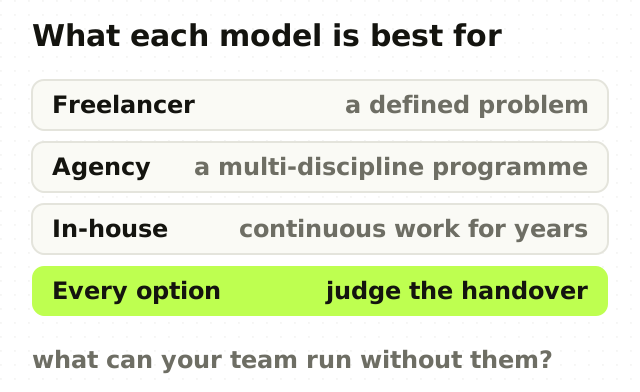
- A senior freelance product designer. Best for a defined problem, such as a first version, a redesign of one area, an audit or a design sprint, or for fractional work a few days a week. You get the most senior attention per hour, because the person you speak to is the person doing the work. The limit is capacity: one person cannot staff three streams at once.
- A UX or product design agency. Best for a large programme that needs several disciplines at once: research, design, content, front-end and project management. You get breadth and capacity, and someone else handles staffing. The limit is cost and seniority per hour, and the handover at the end.
- An in-house hire. Best when there is continuous design work across the product for years, and someone in the company can manage a designer. You get continuity and deep product knowledge. The limit is time to hire and the risk of a poor fit.
The handover is the real cost
Whoever designs the product, your team will live with the result long after the engagement ends. The most expensive outcome is not a high quote. It is a beautiful set of files your engineers cannot build from, or a system nobody on your team can extend.
Ask every option the same question: what will my team be able to run without you? Good answers include a component system with its states documented, a written log of the decisions and why they were made, and files organised the way the product is built. The same test applies to choosing a website partner, which is the argument in how to choose a B2B software website design agency.
Continuity: who is in the room next quarter
Design decisions compound. The person who designed the onboarding knows why the second step exists, and that knowledge is lost when they move on.
For a freelancer, ask about availability over the next six months and what happens if they are unavailable. For an agency, ask who specifically will work on the account, and whether they will still be on it in three months. For an in-house hire, the continuity is the point, and the risk moves to whether they stay.
Seniority per hour
A day rate hides how much senior thinking you actually get. An agency day rate often blends senior and junior time. A freelancer's day rate is usually one senior person. A salary buys whatever seniority you hire, full-time, plus the cost of managing them.
The question worth asking is how many hours of the most senior person's judgement the engagement includes, because the decisions that shape a product are made in those hours.
A short decision guide
- One defined problem and a need to move quickly: a senior freelancer or a fixed design sprint.
- Ongoing design decisions every week, but not a full-time role yet: a fractional designer.
- A large programme across several products and disciplines at once: an agency.
- Continuous design work for the foreseeable future, and someone to manage it: an in-house hire, possibly after a fractional period that helps scope the role.
Questions to ask whoever you shortlist
- Who exactly will do the work, and will they be in our planning sessions?
- What will we receive at the end, and could our engineers build from it without you?
- Tell us about a time you advised a client not to do what they asked.
- How do you work with our existing engineers and product manager?
- What happens if you are not available when we need changes?
The way someone answers the third question tells you most. Designer Fund's and Unusual Ventures' guides to hiring designers both stress judgement over portfolio polish, and a partner who has pushed back on a brief before is one who will tell you when yours is wrong.
The point
The cheapest option on paper is often not the cheapest once the handover and continuity are counted. Decide which risk you can manage, then choose the model built to reduce the others. If the decision is between a freelancer and a hire, the four-sprint way I run engagements shows what a defined project leaves behind.
Frequently asked questions
- Is it better to hire a freelance product designer or an agency?
- It depends on the problem. A senior freelance product designer suits a defined problem or part-time ongoing work, and gives the most senior attention per hour. An agency suits a large programme that needs several disciplines at once. Compare the handover and continuity each offers, not just the rate.
- How do I choose between a freelancer, an agency and an in-house designer?
- Choose by the risk each leaves you with. A freelancer brings capacity and continuity risk, an agency brings seniority and handover risk, and an in-house hire brings time-to-hire and fit risk. Pick the risk your team can manage best, then compare costs, and always ask what your team will be able to run afterwards.
- What should a product design handover include?
- A useful product design handover includes design files organised the way the product is built, components documented with all their states, a written log of the main decisions and why they were made, and a walkthrough with the engineers who will build it. Your team should be able to continue without the designer.
- Why do agency day rates differ from freelance rates?
- Agency day rates usually cover a blend of senior and junior staff, project management and overhead, while a freelance day rate is usually one person's time. That makes the numbers hard to compare directly. The more useful comparison is how many hours of the most senior person's judgement each option includes.
- When should a startup hire an in-house product designer instead?
- Hire in-house when there is continuous design work across the product for the foreseeable future, and someone in the company can manage and support a designer. Before that point, a freelancer or fractional designer is often more effective, and can help write the role and interview candidates when the time comes.
Sources
This thinking, applied
Share this