Name the website problem, not the output
"We need a redesign" is not a brief. It describes an output.
A stronger brief names the business failure. Prospects do not understand the product before sales calls. Paid campaigns land on a generic homepage with weak message match. Enterprise buyers cannot find security or integration proof. The product moved upmarket but the site still signals early-stage. Marketing needs fifteen pages this quarter and every one becomes a custom design project. The site is slow, inaccessible or difficult to maintain.
The right agency for the first problem may be wrong for the last. That is why best-agency lists are a poor buying mechanism: they flatten different jobs into one ranking.
Know which kind of partner you are buying
Most agencies sit between five archetypes.
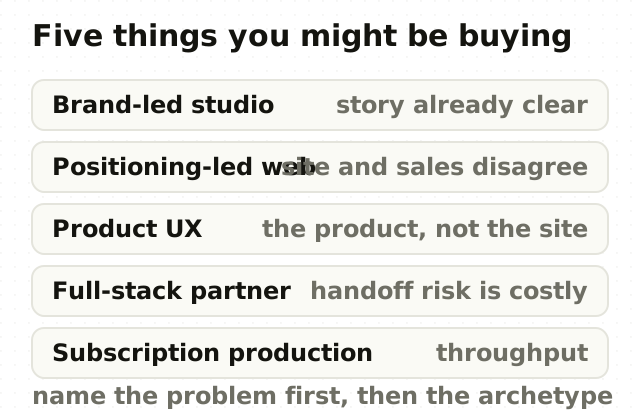
- Brand-led studio. Strong on identity, art direction and a memorable first impression. Best when the story is already clear. Risk: beautiful work with weak content architecture or post-launch autonomy. 2. Positioning-led web agency. Starts with ICP, category, message, proof and conversion path. Best when the site and the sales narrative disagree. Risk: visual craft or engineering may be less differentiated. 3. Product UX agency. Excellent at workflows, dashboards and complex software interaction. Best for the product itself. Do not assume that translates to a marketing site; the users, frequency and success metrics differ. 4. Full-stack design and development partner. Owns strategy through launch. Best when handoff risk is expensive or the internal team is lean. Risk: breadth can hide shallow senior attention. 5. Subscription production service. Useful when the system already exists and the problem is throughput. A poor substitute for repositioning if the model assumes a task queue rather than discovery.
You may need a hybrid. You should still know which capability leads the engagement.
The eight things I would verify
They diagnose before they prescribe. Send a short brief and watch the questions. A strong partner asks about ICP, sales motion, conversion path, acquisition channels, content operations, proof and what changed in the business. A weak process moves straight to style references and page count. You are testing whether they can turn ambiguity into a design problem worth solving.
Case studies explain decisions, not only screens. A useful one lets you reconstruct the problem: what was wrong, what evidence shaped the direction, what changed in messaging or architecture, what trade-offs were made, and what happened afterward. Do not punish an agency for lacking revenue data they were never permitted to publish. Look for live sites, named clients, referenceable stakeholders and clear authorship.
They understand B2B buying complexity. A B2B site is rarely one persona clicking buy. It supports champions, evaluators, executives, security and procurement at different points in a cycle. Ask how they decide where proof, integrations, security, implementation detail and primary actions go. The answer should sound like buyer architecture, not a default section order.
Implementation quality is part of the portfolio. Open the live work. Resize it. Use a keyboard. Test forms. Check mobile. Look for layout shift. Does the production build still resemble the case-study mockup? Google defines Core Web Vitals around loading, responsiveness and visual stability, and W3C recommends WCAG 2.2 as the current accessibility standard. They do not need perfect scores. They need a real QA process rather than launch-week cleanup.
The website can grow without them. This is the criterion teams discover too late. Ask what happens when marketing needs a use-case page ninety days after launch. Do they get reusable sections, tokens, component documentation and CMS models? Or a homepage and a folder of static designs? A B2B site does not need an enterprise design-system programme, but it needs enough system thinking that page velocity does not destroy consistency. That is the same failure mode as blaming a component library for what are really product decisions.
SEO migration is a design requirement. If you have organic traffic, ask how they inventory URLs, preserve or deliberately change architecture, map redirects, handle canonicals and structured data, and monitor after launch. A redesign that improves the homepage while deleting years of search equity is not a successful redesign.
You know who does the work. Pitch-team quality is not delivery-team quality. Ask who owns strategy, copy, design, development and QA, how much senior time is included, what is subcontracted, and who decides when disciplines disagree. Then speak to those people before signing.
Ownership and handover are explicit. Before kickoff, know who owns the design files, source code, repository, CMS account, analytics properties, domains, fonts and licences. Confirm hosting, deployment and post-launch support. Dependency should be a conscious choice, not a surprise created by missing access.
The first-call questions that reveal most
Ask every shortlisted agency the same questions and compare the reasoning rather than the answers.
- What problem do you think we are actually hiring you to solve? 2. What would make you tell us not to redesign yet? 3. Show us a project where positioning or content changed the visual brief. 4. Show us the production site, not only the case study. 5. What does our marketing team own after launch? 6. How do you stop a design system becoming rigid page templates? 7. How do you protect existing search performance during a rebuild? 8. What accessibility and performance checks are part of done? 9. Who specifically will be in our weekly reviews? 10. Tell us about a client request you pushed back on because it would have hurt the result.
The last one matters most. A strategic partner has evidence of disagreement handled well.
A scorecard worth using
If procurement needs a number, score what predicts the work rather than aesthetic taste. Problem framing and strategic depth, twenty points. Relevant B2B software proof and references, fifteen. Messaging, information architecture and conversion thinking, fifteen. Production development quality, fifteen. Design-system and CMS scalability, ten. SEO, performance and accessibility process, ten. Senior team continuity, ten. Ownership and handover clarity, five.
Then add one unscored question: do we trust these people to tell us when our brief is wrong?
Red flags I would take seriously
They quote a full redesign before understanding the business change behind it. Every case study uses the same visual language regardless of category. The portfolio is almost entirely static mockups with no live work. They say SEO-friendly but cannot explain migration or indexation. Accessibility means only colour contrast. A design system is offered as a paid folder of components with no contribution rules. The senior people disappear after the pitch. The proposal describes deliverables in detail but cannot state the decision each one supports. The contract leaves code, CMS or analytics ownership ambiguous. They agree to every requirement without challenging scope or sequence.
Stage fit beats prestige
Pre-product-market-fit companies often need a sharp credibility page and faster learning, not a six-figure brand platform. Teams with a proven acquisition motion may need conversion and system depth. Later-stage teams may need research, governance, localisation and a larger stakeholder process.
The prestigious agency can still be the wrong agency if its process is built for a different stage, budget and decision environment.
The point
You are not choosing who makes your next homepage pretty. You are choosing the operating model your marketing site will inherit.
The right partner leaves three things behind: a clearer story, a site that works in production, and a system your team can extend without quality collapsing.
If the engagement creates a beautiful dependency, it solved half the problem.
Frequently asked questions
- How do I choose a B2B SaaS website design agency?
- Start by naming the business failure rather than asking for a redesign. Fuzzy positioning needs strategic depth; weak conversion needs experimentation depth; slow page production needs system depth; a fragile site needs engineering depth. Then verify diagnosis quality, live production work, post-launch autonomy, search migration process and who will actually staff the account.
- What should I look for in an agency's case studies?
- Decisions, not only screens. A useful case study lets you reconstruct what was wrong, what evidence shaped the direction, what changed in messaging or architecture, what trade-offs were made and what happened afterwards. Open the live site too, since production quality often diverges from the mockups a case study presents.
- What questions should I ask a website design agency?
- Ask what problem they think you are hiring them to solve, what would make them tell you not to redesign yet, what your team owns after launch, how they protect search performance during a rebuild, and about a client request they pushed back on. The last reveals whether they will challenge a brief that is wrong.
- Who should own the website files and code after a redesign?
- You should, by default. Agree before kickoff who holds the design files, repository, CMS account, analytics properties, domains, font and stock licences, and how deployment works. Ongoing support can be a deliberate choice, but dependency created by missing access is a failure of the contract rather than a service.
Sources
This thinking, applied
Share this